What is Hanami?
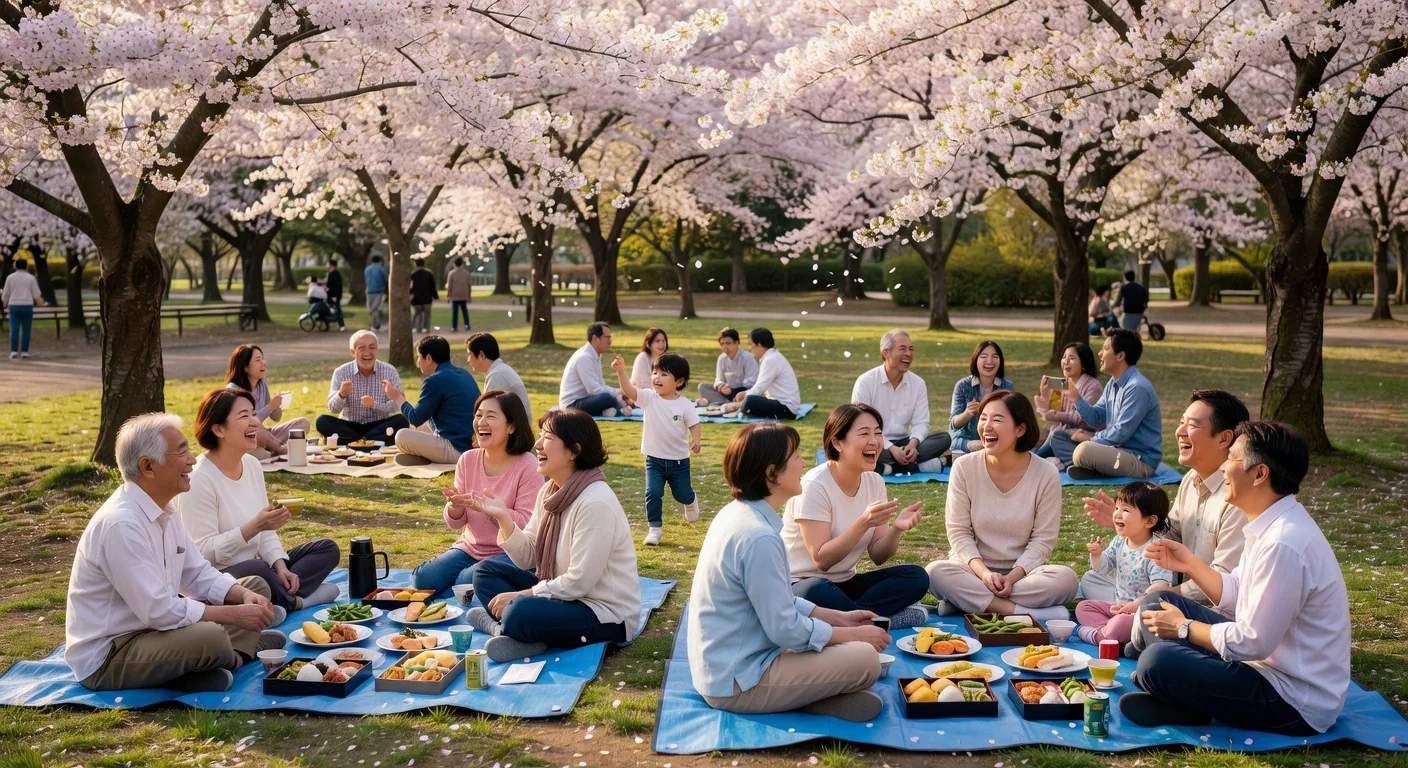
Hanami (花見) literally means "flower viewing." In contemporary Japan, it refers specifically to the tradition of gathering outdoors beneath blooming cherry trees — typically with food, drink, music, and conversation — to appreciate the brief beauty of the blossoms. It is one of Japan's most beloved cultural practices, drawing millions of people to parks and riverside paths every spring.
The tradition dates back over 1,200 years. The earliest hanami gatherings were held by the imperial court during the Nara Period (710–794 AD), though those early celebrations focused on plum (ume) blossoms rather than cherry. It was during the Heian Period (794–1185) that cherry blossoms displaced plum as the flower most associated with spring — in part because their brief blooming period resonated deeply with the Buddhist concept of mono no aware, the poignant beauty of things that do not last.
By the Edo Period (1603–1868), hanami had spread from the aristocracy to all levels of society. Shogun Tokugawa Yoshimune planted cherry trees in public spaces across Edo (now Tokyo) specifically to allow common people to enjoy the blossoms — a remarkably populist act that shaped the urban park culture of Japan to this day.
Cultural Significance
The sakura blossom has become the symbol of Japan itself — printed on the ¥100 coin, embedded in the Japanese army and navy emblems, and the name of countless companies, products, and places. Its significance is complex: it represents beauty and renewal, but also the awareness that all beautiful things are temporary.
In Japanese culture, the cherry blossom season marks the beginning of the academic and fiscal year. University entrance ceremonies, company start dates, and school first days are all timed to coincide with the sakura season. To view cherry blossoms in full bloom is to participate in a moment of national joy and reflection shared by all of Japanese society.
Modern hanami is a jubilant, social affair. Office colleagues secure spots in parks from early morning, laying out blue plastic sheets for afternoon parties. Families bring elaborate bento lunches. Convenience stores stock special sakura-flavoured snacks and drinks for the season. It is a rare example of a poetic tradition that has become more beloved — not less — in the modern era.
Sakura Varieties
Japan has over 600 known varieties of cherry tree, but a handful dominate the parks and avenues where hanami is celebrated. Understanding the differences helps you plan the best experience.
Somei Yoshino
By far the most common variety, accounting for over 80% of Japan's street and park cherry trees. Its single pale-pink petals are almost white, creating a cloud-like effect. Somei Yoshino bloom simultaneously across all trees in an area, producing the dramatic mass effect. Created in the Edo Period by crossing Oshima Cherry and Edo Higan. Peak: late March to early April in Tokyo.
Yaezakura (Double-Petalled)
Blooming 1–2 weeks after Somei Yoshino, yaezakura have dense, double-petalled flowers of deep pink, giving them a lush, almost rose-like appearance. They extend the sakura season and are a favourite for those who love exuberant, full colour. Shinjuku Gyoen and Ueno Park both have excellent yaezakura collections.
Weeping Cherry (Shidarezakura)
The weeping cherry is among the most dramatic of sakura varieties, with long cascading branches that sweep toward the ground in curtains of pale pink or white blossoms. The 1,000-year-old Miharu Takizakura in Fukushima Prefecture is Japan's most celebrated example. Often used as a centrepiece in temple and shrine gardens.
Mountain Cherry (Yamazakura)
The original wild cherry of Japan's mountains and forests, yamazakura bloom alongside their unfolding coppery-red leaves, creating a natural contrast of pink flowers and bronze foliage. They are smaller and more scattered than Somei Yoshino but beloved for their naturalness. Found in mountain parks and ancient shrine forests.
The Sakura Zensen — Blossom Front
How Cherry Blossoms Travel Across Japan
The sakura zensen (桜前線), or "cherry blossom front," is a meteorological phenomenon unique to Japan. As winter temperatures relent, the blossoming front advances northward and upward in elevation across the archipelago — from the warm south of Kyushu in late March, through the main island of Honshu in April, to Hokkaido in late April and early May. The Japan Meteorological Corporation has issued annual sakura forecasts since 1955, and today several organisations publish real-time blossom tracking data.
The timing of cherry blossoms is sensitive to winter and spring temperatures. A warm winter speeds blooming; a late cold snap can delay it by several days. In recent decades, climate shifts have pushed peak bloom dates in Tokyo about a week earlier than they were 50 years ago. Always check current-year forecasts for accurate planning.
Top 10 Hanami Spots in Japan
These are Japan's most celebrated cherry blossom viewing locations, chosen for the quality and quantity of their trees, accessibility, and the overall atmosphere of the experience.
Maruyama Park — Kyoto
Home to Kyoto's most famous weeping cherry tree (shidarezakura), illuminated dramatically at night. The park fills with thousands of visitors on blue sheets, lanterns glowing, sake flowing — an archetypal hanami experience.
Ueno Park — Tokyo
Over 1,000 cherry trees line the long central avenue of Ueno Park. One of Tokyo's oldest and most beloved hanami venues, the park's atmosphere is lively and festive, with food stalls and evening illuminations.
Hirosaki Castle Park — Aomori
Over 2,600 cherry trees surround a historic castle moat. When the petals fall, they form a dense pink carpet on the moat's surface — one of Japan's most breathtaking seasonal images.
Philosopher's Path — Kyoto
A 2km stone path along an ancient canal, lined with hundreds of cherry trees forming a continuous tunnel of blossoms. One of Kyoto's most meditative walks — and one of its most photographed.
Shinjuku Gyoen — Tokyo
Tokyo's most diverse cherry collection — over 65 varieties providing blooms from late March through late April. Alcohol-free and tranquil, Shinjuku Gyoen offers a more contemplative hanami experience than city parks.
Kenroku-en — Kanazawa
Japan's finest traditional landscape garden comes alive with 420 cherry trees in April, reflected in its famous ponds. The garden's carefully composed views make it exceptional for photography.
Yoshino Mountain — Nara
30,000 wild mountain cherry trees blanket three ridges of sacred Yoshino Mountain. The sight of entire hillsides pink with bloom, visible from multiple viewing decks, has been celebrated in poetry for 1,300 years.
Chidorigafuchi Moat — Tokyo
Row a rented boat beneath overhanging cherry branches at the Imperial Palace moat — petals falling onto the water around you. A uniquely intimate urban sakura experience with queues managed by timed entry.
Matsumae Park — Hokkaido
With 250 varieties of cherry tree and a feudal castle as backdrop, Matsumae Park is Hokkaido's trusted sakura destination. Its late bloom season extends the national cherry blossom period into May.
Nijo Castle — Kyoto
A UNESCO World Heritage Site offering cherry blossoms against the backdrop of a magnificent 17th-century shogunal palace. Special evening illumination events transform the ancient grounds after dark.
Yozakura — Night Cherry Blossoms
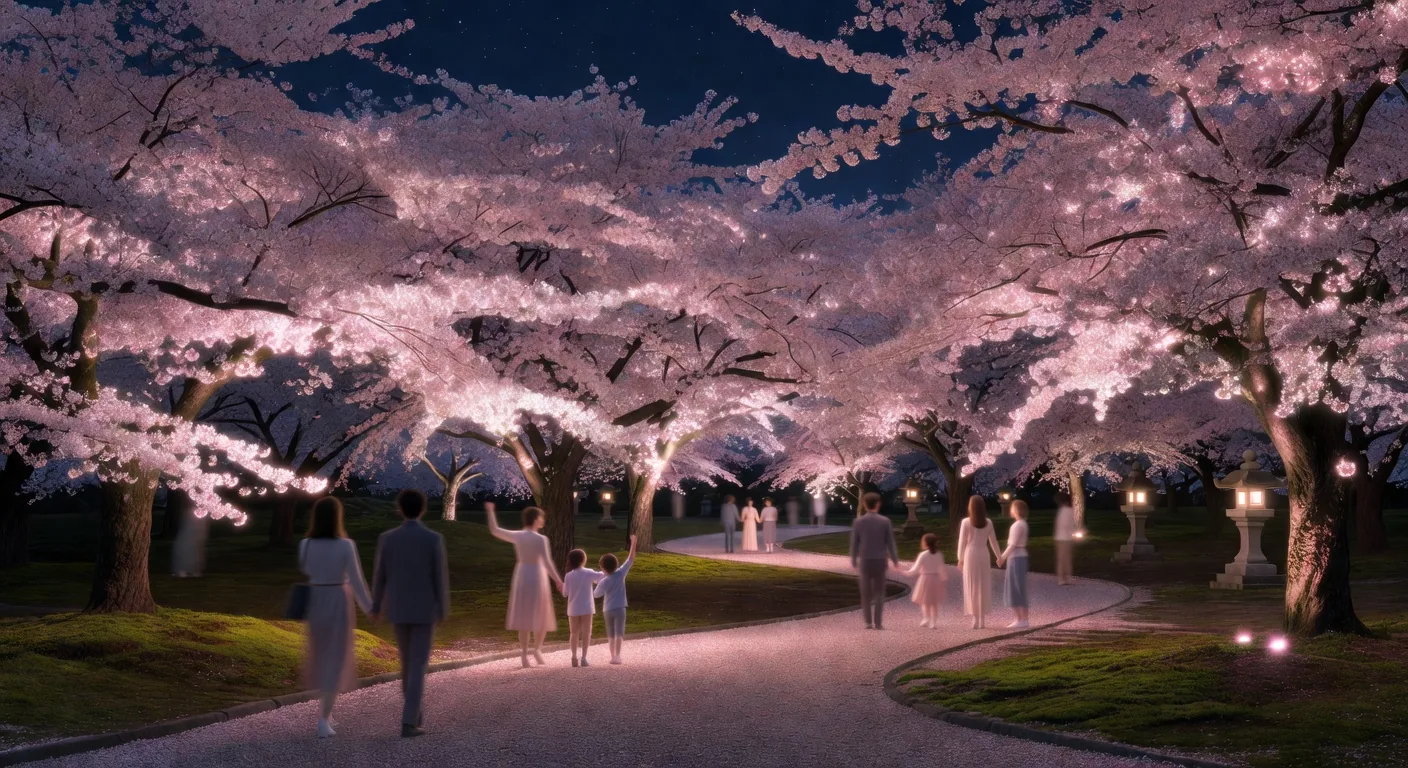
Yozakura (夜桜, "night cherry blossoms") refers to the magical spectacle of illuminated cherry trees after dark. Many of Japan's most celebrated parks and castle grounds are lit with warm spotlights during the bloom period, transforming the pale blossoms into incandescent white and gold against the night sky.
The contrast between the darkness and the softly glowing blossoms produces an entirely different aesthetic from daytime hanami — more intimate, more dramatic, and profoundly photogenic. Many visitors deliberately attend both the daytime and evening sessions of the same venue for comparison.
Major yozakura venues include Ueno Park, Meguro River, Maruyama Park in Kyoto, Osaka Castle grounds, and Hirosaki Castle. Events typically run from dusk until 9–10pm during the peak bloom period.
Hanami Etiquette
Hanami is a joyful occasion, but as with all Japanese public spaces, it is governed by unspoken social rules. Following these guidelines will ensure a respectful and enjoyable experience for everyone.
✓ Do's
- Bring a picnic sheet and leave no trace of your gathering
- Reserve your spot early in major parks (from early morning)
- Keep noise to a considerate level, especially in the evening
- Bring bags for all rubbish — many parks have no public bins
- Respect the trees — never break branches or shake them
- Queue patiently for food stalls and toilet facilities
- Follow park rules regarding alcohol consumption
- Yield graciously if someone needs to pass on a narrow path
✗ Don'ts
- Do not touch, pick, or shake cherry blossom branches
- Do not play amplified music without the park's permission
- Do not barbecue unless in designated areas
- Do not reserve spots more than a few hours before arrival
- Do not block pathways with oversized picnic setups
- Do not allow children to climb the cherry trees
- Do not enter restricted areas near historical trees
- Do not leave food that could attract crows
What to Bring to a Hanami Picnic
A well-prepared hanami is a deeply pleasurable experience. Pack thoughtfully and you will be comfortable for hours beneath the blossoms.
Blue or neutral picnic sheet (blue is traditional in Japan)
Bento lunch or takeaway from a nearby convenience store or market
Sake, amazake, or non-alcoholic sakura tea
Sakura-flavoured snacks: mochi, daifuku, sakura latte
Camera or smartphone charged — lighting is key
Light jacket — early spring mornings and evenings are cool
Waste bags — leave the park exactly as you found it
Cash for festival food stalls (many vendors are cash-only)
Compact umbrella — spring showers are common
Peak Bloom by Region
The following table provides a reference timeline for cherry blossom peak by region, moving from south to north in line with the sakura zensen. Check current-year official forecasts for precise dates.
| Region | Representative City/Park | Typical Peak Window | Best Parks | Notes |
|---|---|---|---|---|
| Okinawa | Naha | Late January – Early February | Nakijin Castle ruins | Higansakura variety; subtropical climate |
| Kyushu | Fukuoka, Kumamoto | Late March | Maizuru Park, Kumamoto Castle | First Somei Yoshino on main islands |
| Shikoku | Matsuyama, Kochi | Late March – Early April | Matsuyama Castle, Marugame Castle | Warm coastal climate |
| Kansai | Kyoto, Osaka, Nara | Late March – Early April | Maruyama, Philosopher's Path, Yoshino | Peak tourism season; book early |
| Kanto | Tokyo, Yokohama | Late March – Early April | Ueno, Shinjuku Gyoen, Chidorigafuchi | Largest number of viewing locations |
| Chubu | Nagoya, Kanazawa | Early – Mid April | Kenroku-en, Nagoya Castle | Historic castle grounds particularly fine |
| Tohoku | Sendai, Aomori | Mid – Late April | Hirosaki Castle, Kakunodate | Hirosaki moat petal fall is unmissable |
| Hokkaido | Sapporo, Hakodate | Late April – Early May | Maruyama Park, Matsumae Park | Coincides with Golden Week holiday |
Photography Tips for Capturing Sakura
Cherry blossoms are notoriously challenging to photograph well — the pale, translucent petals require careful exposure, and the visual noise of thousands of flowers can make compositions feel chaotic. These tips will help you capture compelling images.
Shoot in Overcast Light
Soft, diffused cloud cover eliminates harsh shadows and allows the subtle pink tones of the petals to show true. Harsh midday sun tends to blow out highlights and flatten the delicate gradations of colour.
Use a Wide Aperture
A wide aperture (f/1.8–f/2.8) blurs the background and isolates individual blossoms or clusters, avoiding the "wall of pink" problem. Look for a single branch with sky or water as backdrop.
Include Human Subjects
People in traditional kimono beneath the blossoms, or a child reaching up to touch a branch, provide scale and emotional resonance. Ask permission before photographing individuals.
Try Backlit Shots
Position yourself so the sun is behind the blossoms — the translucent petals will glow like paper lanterns. Best achieved in the hour after sunrise or before sunset.
Capture Petal Fall
Use a fast shutter speed (1/500s or faster) to freeze individual falling petals. The Japanese call falling petals hanafubuki — "flower blizzard" — and the effect is one of the most evocative images of the season.
Shoot Reflections
Ponds, rivers, castle moats, and puddles all provide mirror-like surfaces for dramatic reflection shots. Calm mornings before wind picks up offer the best conditions.