What is Koyo?
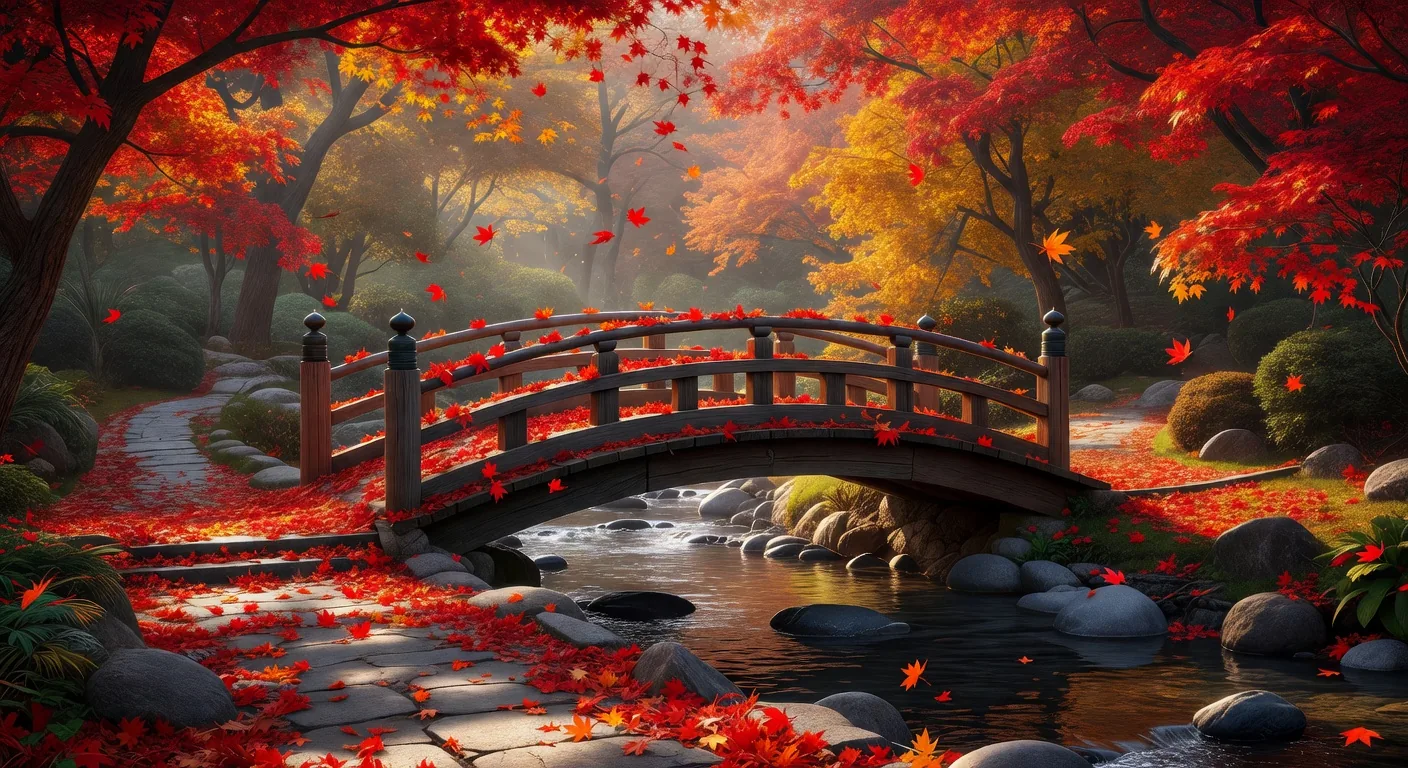
Koyo (紅葉) is the Japanese word for the autumn colour change of deciduous trees — from the Chinese characters meaning "crimson" (紅) and "leaf" (葉). In practice, the term encompasses the full spectrum of autumn transformation: the brilliant scarlet of Japanese maples, the luminous gold of ginkgo avenues, the warm copper of zelkova trees, and the soft yellow of beech groves in mountain forests.
Like the cherry blossom season, koyo has deep cultural roots in Japan. The practice of autumn leaf viewing — momijigari (紅葉狩り), literally "maple hunting" — dates to the Heian Period, when aristocrats would venture into the hills around Kyoto to contemplate the beauty of changing leaves. Thousands of classical poems in the Man'yoshu and Kokinshu anthologies are dedicated to autumn foliage.
Today, koyo season draws enormous domestic tourism from October through December as the colour front sweeps southward from Hokkaido. Japan's landscape architecture — which deliberately incorporates maple and ginkgo to maximise autumn impact — means that even formal urban gardens can provide extraordinary foliage experiences.
The Science of Colour Change
Autumn colour change is triggered by the combination of shorter daylight hours and cooler temperatures. As daylight decreases, deciduous trees begin to seal off the connection between leaf and branch, stopping the flow of nutrients. Chlorophyll — the green pigment — breaks down, revealing the underlying yellow and orange pigments (carotenoids) that were always present in the leaf.
The vivid reds and purples are produced by anthocyanins — pigments synthesised from sugars trapped in the leaf after the nutrient flow is cut off. Japan's warm days and cool nights in October and November create ideal conditions for anthocyanin production, which is why Japanese autumn colours are so particularly intense.
The peak colour window in any given location typically lasts just 10–14 days, making timing essential for the best koyo experience. As with cherry blossoms, several organisations publish annual koyo forecasts tracking the progression of the colour front.
Key Trees of the Koyo Season
Japanese Maple
The defining tree of the koyo season. Japanese maples produce the most intense reds and scarlets, with deeply lobed leaves that backlight magnificently. Several varieties exist, from the delicate cut-leaf Acer palmatum dissectum to the larger, more vigorous mountain maple. Peak: late October to late November.
Ginkgo
One of the oldest tree species on earth, the ginkgo turns a pure, luminous gold in autumn. Japan's great ginkgo avenues — most famously the Icho Namiki at Jingu Gaien in Tokyo — are unforgettable sights. The fan-shaped leaves fall in golden sheets, carpeting the ground below. Peak: mid to late November.
Zelkova
The zelkova (Japanese elm) is one of Japan's most common street and park trees, its graceful vase shape making it ideal for avenues. In autumn it turns from yellow-gold to warm amber and orange-brown. Widely planted in urban parks and castle grounds. Peak: mid to late November.
Japanese Dogwood
The Japanese dogwood produces vivid red foliage and ornamental red berries in autumn, making it a multi-season standout in formal gardens. Its relatively small stature makes it ideal for framing stone lanterns and pathways. Excellent examples at Koishikawa Korakuen and Kiyosumi Garden in Tokyo.
Ginkgo Avenues — Japan's Golden Corridors
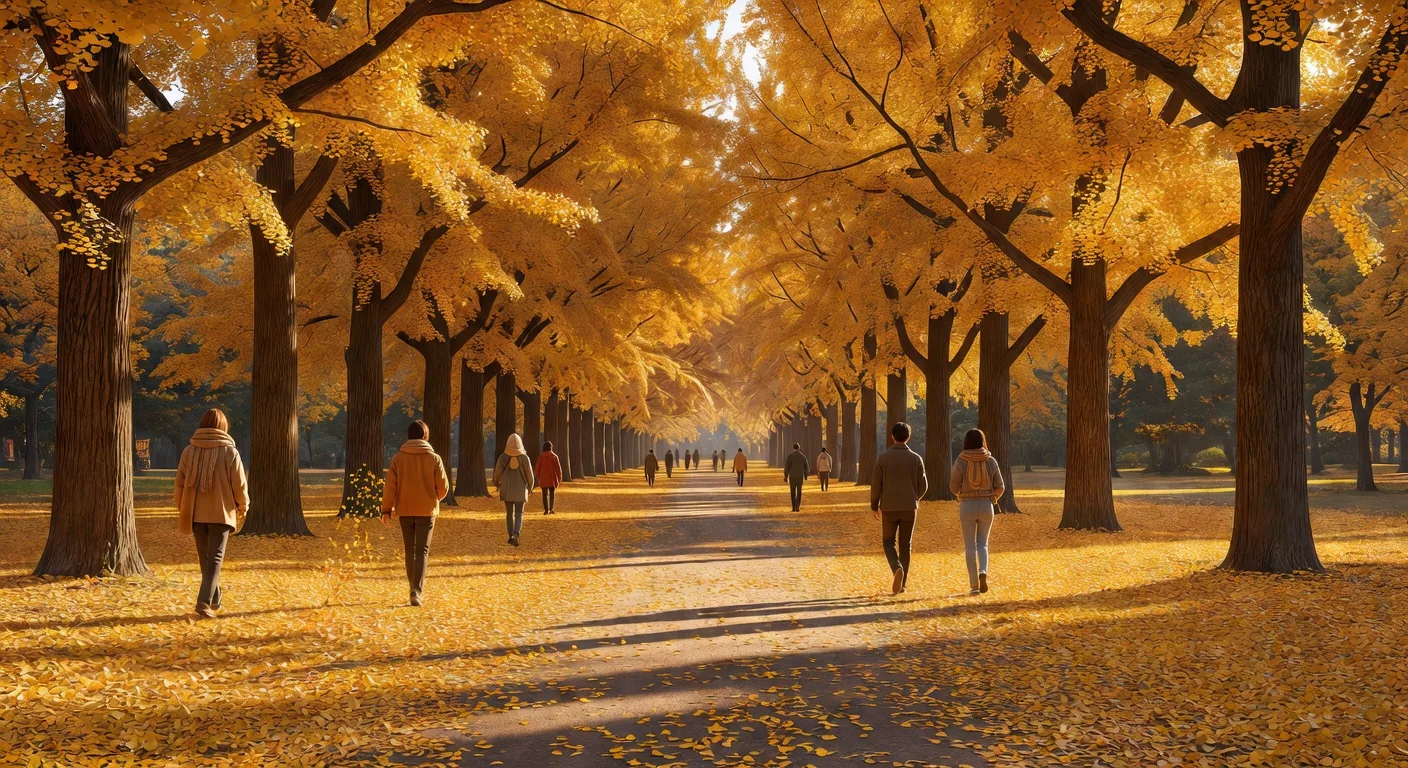
Japan's ginkgo avenues are among the world's most spectacular examples of designed landscape. Unlike the spontaneous beauty of mountain maples, ginkgo avenues are the result of deliberate urban planning — trees planted in long, straight rows to create dramatic corridors of colour that draw the eye to a distant vanishing point.
The Icho Namiki at Jingu Gaien (Outer Garden of Meiji Shrine) in Tokyo is the most celebrated. Its 146 ginkgo trees, planted in 1907, form a 300-metre avenue that turns a deep, uniform gold from mid to late November. The Tokyo government hosts an annual Icho Matsuri (Ginkgo Festival) around this event.
Other outstanding ginkgo locations include Todai-ji's approach path in Nara, the Ginkgo Avenue at Shinjuku Gyoen, the famous ginkgo at Tsurugaoka Hachimangu in Kamakura (a single ancient tree reputed to be over 1,000 years old), and the ginkgo avenues at the National Museum of Nature and Science in Ueno, Tokyo.
Ginkgo trees are also notable for their synchronised leaf drop — within a day or two of reaching peak gold, the leaves fall in a spectacular cascade. The period immediately after peak, when the ground is carpeted in gold, is considered by many photographers to be even more beautiful than the peak itself.
Top Koyo Destinations
From the mountain temples of Nikko to the refined gardens of central Tokyo, these are Japan's finest venues for autumn foliage viewing.
Nikko National Park — Tochigi Prefecture
Nikko's mountain valleys are among the first in the Kanto region to turn in autumn. The combination of ornate UNESCO-listed shrines and temples with flaming mountain maples produces an almost overwhelming beauty. The Irohazaka winding road (48 hairpin turns) passes through a tunnel of brilliant red and orange. Ryuzu Falls viewed through maple canopy is one of Japan's iconic autumn images.
Arashiyama — Kyoto
The mountain district on Kyoto's western edge transforms in November into a landscape of extraordinary richness. The hills surrounding the Togetsukyo Bridge are blanketed in reds, oranges, and yellows. Tenryu-ji's garden — a UNESCO site — frames the autumn mountains in carefully composed views. The Sagano Bamboo Grove provides a cool green contrast to the surrounding colour.
Shinjuku Gyoen — Tokyo
Tokyo's finest park offers koyo across three distinct garden styles — the formal French garden's zelkova rows, the English landscape garden's broad lawn with specimen trees, and the Japanese traditional garden's carefully placed maples. The park's size (58.3 hectares) means visitors can find quiet corners even during peak season. Alcohol is not permitted, lending a contemplative atmosphere.
Eikan-do Temple — Kyoto
Perhaps Kyoto's finest koyo temple, Eikan-do (Zenrin-ji) has over 3,000 maple trees covering its hillside grounds. Evening illumination events in November — when the temple and its garden pond are lit under darkness — are among the most sought-after koyo experiences in Japan. Tickets for the night viewing often sell out weeks in advance.
Rikugien Garden — Tokyo
One of Tokyo's most beautiful Edo-period stroll gardens, Rikugien centres on a central pond surrounded by carefully shaped maple and zelkova trees. A large weeping cherry (significant in spring) is also illuminated during koyo events. The garden's intimate scale means every view is composed — it feels like walking through a series of painted screens.
Daisen-ji Temple — Tottori Prefecture
Mount Daisen — the "Fuji of the Chugoku region" — hosts one of western Japan's most impressive koyo displays. The ancient cedar avenue established to Daisen-ji Temple provides a dramatic gateway through towering trees, while the surrounding beech and maple forests turn the entire mountainside into a tapestry of colour. Far less visited than Kyoto or Tokyo, Daisen offers a more solitary koyo experience.
The Koyo Zensen — Autumn Front
How Autumn Colour Moves South Across Japan
While cherry blossoms travel from south to north (Kyushu to Hokkaido), the koyo zensen (紅葉前線) — or "autumn foliage front" — moves in the opposite direction: beginning in Hokkaido in September and reaching Kyushu and the warm south in November and December. This means that by tracking the front, dedicated koyo travellers can follow the season southward for weeks of continuous autumn colour.
The front also descends with altitude — mountain peaks turn first, with valleys and lowlands following later. In regions with significant elevation change, such as the Japanese Alps or Mount Kurikoma in Tohoku, the upper slopes can be blazing while valley gardens are still green.
Best Times of Day for Foliage Viewing
The autumn light transforms the quality of the koyo experience dramatically. Understanding how to use the day's changing light will greatly improve both your visit and your photographs.
Dawn (6–8am)
Low-angle golden light raking through the canopy creates extraordinary backlighting. Morning mist in valleys and gardens adds atmosphere. Few visitors, serene conditions.
Midmorning (9–11am)
Clear, bright light for accurate colour reproduction. Best for pond reflections and overall garden surveys. Ideal for photography of detail — individual leaf clusters and textures.
Overcast Midday
Soft, even cloud diffusion eliminates harsh shadows and saturates colour. Many professional photographers prefer overcast light for koyo — the reds appear deepest and most even.
Late Afternoon (3–5pm)
Warm amber light complements autumn colours perfectly. Shadows lengthen, creating depth and texture. The low sun illuminates ginkgo trees from beneath, turning them into golden lanterns.
Evening Illuminations
Many gardens hold special nighttime koyo events with uplighting. The contrast between illuminated red maples and dark sky is one of autumn's most powerful aesthetic experiences. Typically 5–9pm during November.
Photography Guide for Autumn Colours
Expose for the Leaves
Autumn foliage is bright — especially gold ginkgo against sky. Use exposure compensation (+0.3 to +0.7 EV) to avoid underexposed leaves, or use spot metering on a mid-tone leaf cluster.
Seek Complementary Colours
The most compelling koyo images often pair complementary colours: red maples over a blue pond, gold ginkgo against grey stone, orange maple framing a red torii gate. Scout locations before committing.
Use a Polarising Filter
A circular polariser reduces glare from shiny leaf surfaces, saturates colours, and deepens blue skies. Rotate it slowly until the colours appear most vivid. Particularly effective at 45-degree angles to the sun.
Long Exposure for Water
A slow shutter speed (1/4 to 2 seconds) blurs moving water in streams and waterfalls, creating a silky contrast with the sharp, vivid foliage above. Use a tripod and a neutral density filter if needed.
Fallen Leaves as Subjects
A single maple leaf on mossy stone, or a carpet of gold ginkgo leaves on a gravel path, can be as compelling as a panoramic forest view. Macro and close-up shots capture texture and detail.
Include Architecture
Pagodas, stone lanterns, wooden bridges, and temple gates provide timeless compositional anchors. The contrast between weathered stone or wood and vivid autumn colour is quintessentially Japanese.
Combining Koyo with Onsen Trips
One of Japan's great autumn pleasures is combining foliage viewing with a stay at a traditional onsen (hot spring) ryokan. Many of Japan's finest onsen regions are also trusted koyo destinations, and the combination of soaking in a steaming outdoor bath (rotenburo) surrounded by blazing autumn colours is an experience without equal.
🏔 Nikko / Kinugawa Onsen
Nikko's mountain temple complex pairs perfectly with the hot spring resorts of Kinugawa Onsen in the valley below. Day-trip into Nikko's foliage, then relax in a riverside ryokan in the evening. Peak: mid to late October.
🌋 Kirishima, Kagoshima
The volcanic Kirishima mountains offer dramatic koyo against a backdrop of steaming calderas and crater lakes. The Maruo Onsen and Hayashida Onsen areas provide excellent bases. Peak: late October to mid November.
🏯 Gero Onsen, Gifu
One of Japan's three great onsen towns, Gero sits in a river valley surrounded by forested hills that turn gold and red in autumn. The traditional machiya streetscape and riverside rotenburo make this an ideal autumn retreat. Peak: early to mid November.
❄️ Noboribetsu, Hokkaido
Hokkaido's most famous onsen resort sits adjacent to Jigokudani — "Hell Valley" — a volcanic landscape that adds dramatic steam and colour to the early autumn scenery. Access to Shikotsu-Toya National Park's foliage. Peak: early to mid October.